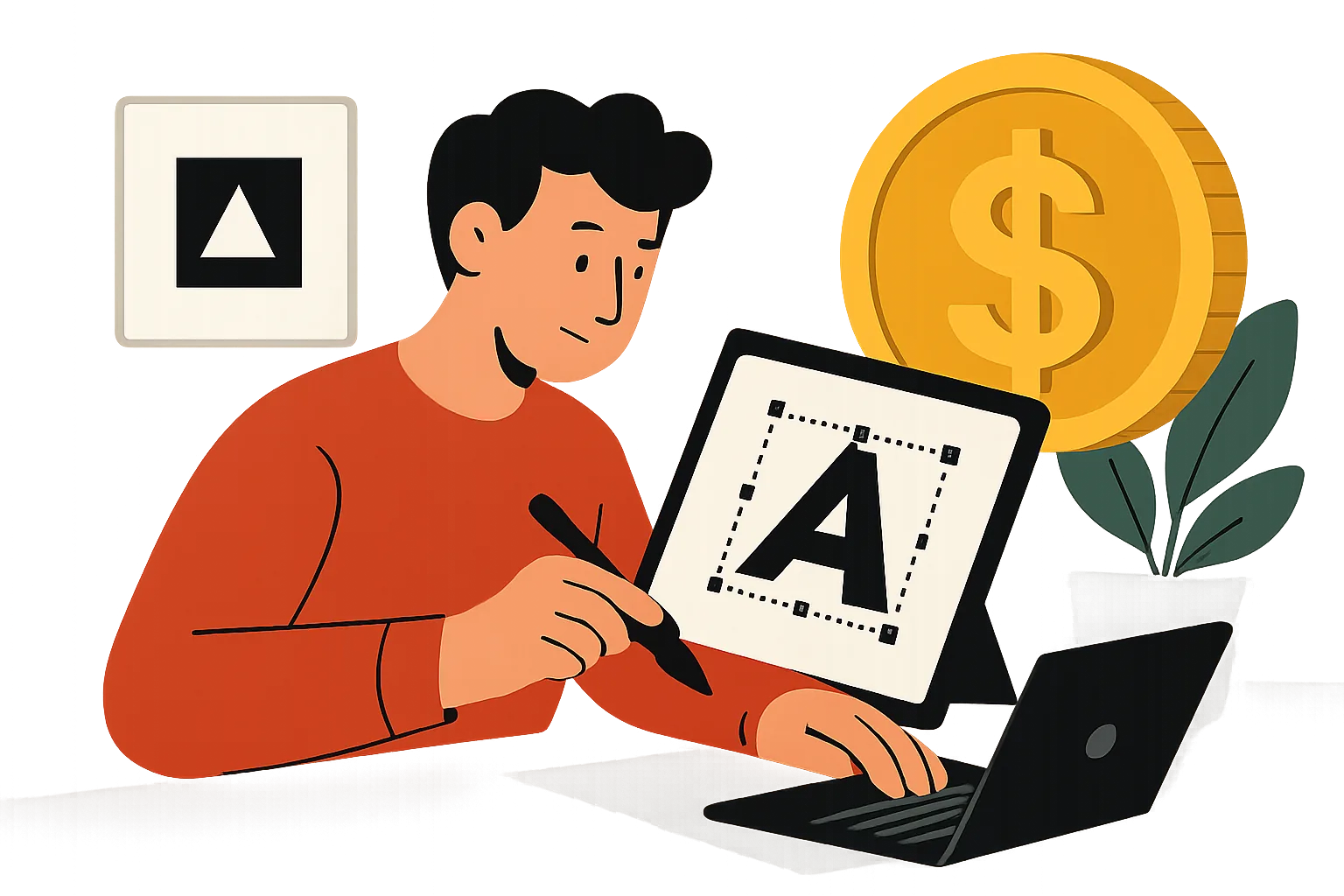
What affects the cost of a freelance logo
When it comes to a logo, many people expect to see one “right” price. But in reality, freelance logo design pricing rarely stays the same, even between two designers with similar portfolios. The final amount depends not only on how polished the portfolio looks, but also on how deeply the designer gets into the task, which is why understanding what affects logo design price matters so much.
The first factor is experience. A beginner usually charges less: they need to build case studies, get reviews, and practice. A specialist with a strong portfolio and a clear style will price the work higher, because the client is buying not just a picture, but judgment, process, and a more predictable result. This is especially noticeable in niches where you can’t afford to “just make a symbol”: medicine, finance, education, B2B.
The second factor is the complexity of the task. It’s one thing to create a clean wordmark for a small workshop, and quite another to invent a symbol for a company that needs an image, character, and a competitive edge. The more meaning has to be packed into one visual system, the more time it takes to find the solution.
The third important point is the number of concepts. Sometimes the client only needs one direction with precise refinement. In other cases, they need several options to choose from, and that is a different level of effort. It’s important to understand: if someone promises three, five, or ten concepts at a very low price, they’re clearly cutting corners either on depth or on time.
Deadlines also affect the price. A rush order is almost always more expensive, because the designer reshuffles their schedule, puts other projects on hold, and works at a faster pace. And speeding up, as we know, is rarely free.
There are also less obvious but important details: preliminary research, reference gathering, competitor analysis, and adapting the logo for avatar, website, packaging, and social media. Finally, preparing the files is not just “sending over an image.” You need source files, vector files, different formats, and sometimes versions for light and dark backgrounds. The wider the package, the higher the price.
How freelance logo pricing works in different order formats
If you look not at an abstract “logo in general,” but at real order formats, the picture becomes clearer. For a simple project — for example, a text-only logo without complex symbolism — the budget is usually lower than for a full brand identity. But even here, it’s important not to confuse simple form with simple work: minimalism often demands more precision than it seems from the outside.
In one scenario, the client orders only a symbol or a typographic version of the name. In another, the logo becomes part of a brand identity: colors, fonts, layout, and sometimes even a set of graphic elements for presentations and social media are chosen around it. Naturally, the second option costs more, because it is no longer one image, but a small system.
Redesign is a separate story. If the company already has recognition, the designer must not just “make something new,” but preserve the recognizable traits while refreshing the visual. This kind of project requires care and attention to detail, especially if the old logo already exists somewhere: on the website, in documents, on packaging, or offline.
A rush order almost always falls into a separate category. Sometimes the task comes in at night and at least a first working version is needed by morning. In that case, the price goes up not because the designer is being difficult, but because time has to be rearranged and the workload is higher. In situations like this, it’s better to agree in advance on what “urgent” actually means: the first sketch, the final version, or the full file set.
Finally, a package with source files and adaptations can differ significantly from a basic offer. Some people only need a logo for a website. Others need versions for print, social media, a mobile app, and promotional merchandise right away. The broader the list of uses, the more work the designer has to do, and the higher the cost.
Logo pricing on freelance: how the quote is formed
For a freelancer, logo pricing usually follows one of three approaches: hourly billing, a fixed project fee, or stage-based pricing. Each approach has its advantages, and the choice should be based not on “what’s customary,” but on the nature of the task.
The hourly model is convenient when the scope of work is unclear in advance. For example, the client is only shaping the idea, and some decisions will be refined during the process. In that case, the designer counts time spent on the brief, analysis, sketches, revisions, and final file preparation. The advantage for the client is that it’s clear what they are paying for. The downside is that the final total may end up higher than expected if the project keeps expanding.
A fixed project price is better suited when the scope is clear. There is a brief, a deadline, the list of work, and the number of revisions. The client knows the budget range in advance, and the designer knows the boundaries of responsibility. This format is usually more comfortable for both sides if the task is clearly defined.
Stage-based pricing is often used for more complex orders. First comes research and concept development, then the chosen direction is refined, and after that the final materials are prepared. This is useful when the client wants to control the process and not pay for the entire scope all at once. By the way, to better understand how to work with a contractor without unnecessary risk, it’s helpful to read how to hire a freelancer safely.
What usually counts as part of the base price? Typically, the brief, one main solution, a few rounds of revisions, the final logo version, and file delivery in the agreed formats. Extra charges apply for anything beyond the base package: additional concepts, rush work, more involved research, unusual adaptations, and an expanded set of formats.
There’s another important nuance: some designers charge separately for transferring rights or preparing a brand book. That’s normal, as long as the terms are laid out in advance and there are no surprises at the end. A quote should not feel like a quest, where the final price only appears after the third revision.
How much logo development costs: the designer’s perspective
The question “how much does logo development cost” often sounds as if we’re talking about one market with the same rules. In reality, it’s more complicated: a beginner, a solid mid-level designer, and an experienced professional all have different pricing expectations and different project structures. If you’re asking how much does a logo cost from a freelancer, the answer depends heavily on who you hire and what the brief includes.
A beginner usually takes on smaller jobs where responsiveness and a willingness to learn matter most. For them, a logo is also a way to learn the workflow: how the brief is set, how feedback is handled, and how the result is packaged. But there’s a risk here too: a low price does not guarantee that the person truly knows how to create logos, rather than just drawing pretty separate images.
A mid-level designer usually works with more confidence. They already have several successful cases, a recognizable style, and practical experience working with clients. Such a designer may charge not only for the drawing itself, but also for part of the analysis, and therefore price the work higher. In return, the client gets a more predictable process and less chance that the project will get stuck at the “let’s try it this way too” stage.
An experienced specialist costs significantly more because they often sell not hours, but the quality of decisions. They spot weak points in the task faster, know how to cut away the unnecessary, and propose solutions that actually work. Sometimes that is exactly what saves the client money: not on the price of the logo itself, but on rework, wasted time, and chaotic revisions.
Looking at it more broadly, a designer may value a project not only by effort, but also by its business value. For a small local workshop, a logo is part of the launch. For a company entering a new market, it’s a tool for recognition and trust. The difference in responsibility is huge, and that is reflected in the price.
What should be included in the final price
To avoid arguing with the designer over nothing, it helps to understand in advance what makes up the final price. A good logo is not just a final file in a nice format. Behind it lies a chain of very specific tasks.
- briefing and task clarification;
- analysis of the niche and competitors;
- search for a visual direction;
- 1–3 concepts or an agreed number of options;
- revisions and refining the chosen solution to the final version;
- preparing files for web and print;
- versions for light and dark backgrounds;
- handover of source files, if included in the agreement;
- brief logo usage guidelines.
The brief is especially important. Without it, the designer starts guessing, and guessing in visual communication is an expensive habit. The more precisely the name, field of work, audience, competitive advantages, and desired brand character are defined, the less time is wasted on endless clarifications.
Usage rights deserve special attention. Sometimes the client only needs a ready file for their own use. In other cases, they need a full rights transfer package so the logo can be used freely in any context. This is best discussed up front, not after the work has already been delivered.
How to tell if the price is fair
The simplest way to judge an offer is not to look at the number in isolation. You need to compare the portfolio, the scope of services, and the working terms. If one designer is cheaper but only provides one sketch and a few weak revisions, while another offers research, several concepts, and source files, it’s not fair to compare those offers directly.
Pay attention to transparency. A reliable professional can usually explain without difficulty what is included in the price, how many revisions are included, when the first version will be ready, and in what format the files will be delivered. If the answers are vague, that’s a reason to be cautious.
The portfolio says a lot too. Look not only at beauty, but also at relevance. A good logo is not necessarily the most striking one. It’s the one that solves the business problem. Sometimes a designer doesn’t have dozens of awards, but does have neat projects with clear logic. And that is much more valuable.
A very low price is not always a bargain. Sometimes it means minimal involvement, a templated approach, or no clear obligations. As a result, the client gets “something nice,” but without strategy, without the right file formats, and without a solid basis for growing the brand later.
If you want to explore more about how a freelancer’s reputation works and why reviews matter, it’s worth reading about freelancer reviews and reputation. For visual tasks, this is especially relevant: good design is rarely created in an atmosphere of distrust and haste.
How to save money without losing quality
You can save money on a logo, but it’s better to do it wisely. The main way to reduce the budget is not to overcomplicate the task where it isn’t necessary. If you need a symbol for a local project, there’s no need to order a full brand ecosystem right away. Sometimes a concise but carefully crafted solution is enough.
A clear brief is the first and cheapest form of savings. When the client already knows the name, field, core values, and constraints, the designer doesn’t have to spend time guessing or reworking. And time, like it or not, is part of the price.
Another way to save is to limit the number of revisions. Not rigidly, but sensibly. If you know decisions will be made quickly, there’s no need to plan for ten rounds of discussion. It’s better to agree in advance: one concept stage, two rounds of revisions, then finalization. This approach keeps both sides disciplined.
Having positioning ready also helps. When the company already has a name, an understanding of its audience, and a communication tone, the designer’s task narrows down to visual translation. But if the brand character has to be invented first and the logo afterward, the budget will almost inevitably grow.
Finally, don’t order unnecessary extras. Sometimes a package includes things you don’t need yet: a complex brand book, dozens of mockups, an expanded system of applications. If the project starts small, only get the work you truly need. The rest can be added later, when the business actually grows.
Conclusion: how much freelance logo design costs and how to choose the best option
In short, freelance logo design pricing depends not on a single number in the price list, but on a combination of factors: the designer’s level, the complexity of the task, the number of concepts, revisions, deadlines, and the contents of the final delivery. So offers should be compared not by “where it’s cheaper,” but by “what exactly do I get for this money.”
To choose the best option, keep a simple checklist in mind:
- look for portfolio examples with similar tasks;
- compare not only the price, but also the scope of services;
- clarify the number of concepts and revisions;
- check whether source files and print-ready formats are included;
- discuss rights transfer in advance;
- don’t agree to a vague quote without clear stages.
A good logo is not a lucky accident and not the loudest number in a proposal. It’s the result of a clear task, good communication, and a fair assessment of the work. And if you approach the choice of designer calmly and without rushing, your chances of getting a strong visual mark are much higher.
To find the right specialist, you can also browse the freelancer directory and compare different designers’ approaches. Sometimes the best option is not the loudest one, but the one who listens carefully and clearly explains what’s included in the work. That’s usually where quality results are hidden.

Comments 0
No comments yet — be the first.