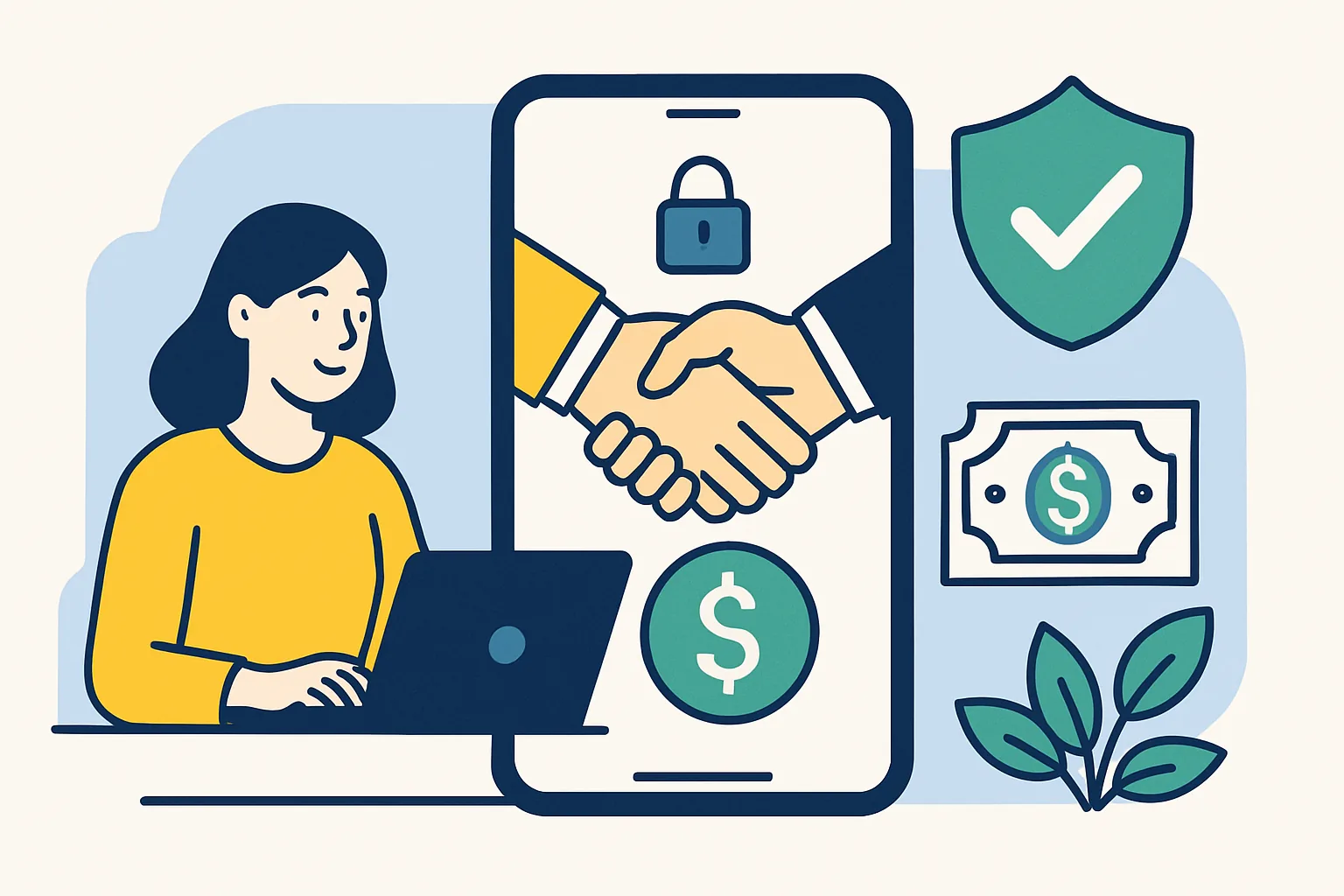
How to safely pay a freelancer through a secure deal: step-by-step instructions
Paying a freelancer is always a matter of trust, but trust should not be blind. This is especially true for remote work, where the client does not see the process in the office, and the contractor cannot simply put the finished result on the table and say, “Here it is, check it.” That is why a secure deal has become the most convenient payment method for many people: the money is there, but it does not go to the freelancer immediately. First comes the work, then the review, and only after that the payment.
If you are wondering how to pay a freelancer safely, the answer is usually to use a protected process that keeps the funds on hold until the deliverable is approved, and it is a simple principle, but there are many nuances. If you ignore them, even a protected format will not save you from disputes. But if everything is set up properly, a secure deal on a freelance marketplace really removes the main risks for both sides. Below, we will look at how it works in practice and what to pay attention to before the first click.
What a secure deal is and when to use it
A secure deal is a mechanism in which the client deposits money not directly to the freelancer, but into a service-protected holding state. The freelancer sees that the funds are reserved, starts work, and after the result is accepted, the client confirms the payment. Different services may call this principle differently, but the essence is the same: the platform acts as an intermediary and controls the movement of funds. In practice, this is an escrow payment for freelancers arrangement that helps both sides feel protected.
For the client, this means less risk of “I paid and got nothing in return.” For the freelancer, it means less risk of doing the work and then hearing, “We can’t pay right now, we’ll get back to you later.” This format is especially suitable when:
- the task has a clear result that can be checked;
- the project is being done for the first time, and the parties have not worked together before;
- the deal amount is significant for you;
- you need to lock in the deadline, scope, and acceptance rules in advance;
- the project has several stages, and it is more convenient to pay as each stage is delivered.
There is also a downside. If you are hiring someone for a very short, almost everyday task built on trust and low risk, a secure deal may seem excessive. But as soon as you are dealing with design, development, writing, marketing, or any work with a result that needs to be evaluated, this format usually wins. In such cases, paying a freelancer without an advance through a protected service gives the calmest possible start to cooperation.
How to choose a platform: secure deal freelance marketplace
When choosing where to conduct the transaction, it is important not to stop at the attractive “protect payment” button. You need not just a marketplace, but a service that truly can hold funds until the work is complete, explains the rules in plain language, and does not shift all risks to one side.
That is exactly how you should look at a secure deal freelance marketplace: as a set of rules, interfaces, and obligations, not as an abstract promise. Before creating a deal, check a few things:
- how the escrow mechanism works and who controls the funds in disputed cases;
- what fees the service charges the client and the freelancer;
- how a dispute is filed and how much time each side has to respond;
- whether the rules clearly explain the refund process;
- whether the brief, files, and project stages can all be attached to one deal;
- how acceptance is confirmed and what counts as silent approval.
A good platform does not hide these conditions deep in the help section. If the rules are vague and the wording is too general, that is a warning sign. Ideally, you should know what will happen at every stage before you pay. If the service does not explain what happens in a dispute, it is better not to experiment.
It is also useful to see how the platform handles ratings and reviews, and this does not replace agreements, but it helps you choose a freelancer with more predictable behavior. A specialist directory can help here too, for example Freelancers — contractor directory | 24 Freelance, where it is easier to compare profiles and see who you are dealing with.
Step by step: how to safely pay a freelancer through a secure deal
Agree on the task and brief. Before the deal, you need to understand exactly what will be done: the scope of work, the result format, deadlines, quality requirements, and the list of source materials. The more precise the description, the lower the chance of conflict. If you have doubts, it is useful to check the material How to hire a freelancer safely in advance.
Create a secure deal on the platform. State the project scope, attach the brief, choose the freelancer, and make sure all important parameters are reflected in the deal card. Do not rely on verbal agreements in messages: what is not included in the terms is harder to prove later.
Deposit the funds into the protected system. At this stage, the money is reserved, but it has not yet been transferred to the freelancer. That is the key advantage of the format: the contractor sees that the budget is confirmed, and you know the funds will not leave early.
Start the work. After payment is confirmed, the freelancer begins the task. If the project is complex, it makes sense to agree on intermediate checkpoints: a prototype, draft, test version, part of the code, or initial design options. That makes it easier to spot issues early.
Review intermediate results. Do not wait until the end if the project can be checked in parts. The earlier you say what needs to be corrected, the fewer conflicts there will be later. By the way, if you need not only to run the deal but also to formulate the requirements properly, it is worth rereading how to write a technical specification.
Accept the work using a checklist. Before confirming payment, compare the result with the brief: does the scope match, are the deadlines met, do the format, technical parameters, sources, and revisions align? Do not rush to click the button just because “it’s already awkward to keep waiting.”
Confirm payment only after checking everything. If everything is in order, confirm the deal. After that, the funds are transferred to the freelancer, and if there are issues, use the revision or dispute mechanism provided by the platform.
In practice, this approach works best when both sides understand that a secure deal is not a pressure tool, but a way to organize the process without unnecessary stress. A well-structured deal saves time instead of wasting it.
Paying a freelancer without an advance: when it is possible
Many clients are interested in paying a freelancer without an advance. Formally, a secure deal is exactly the option where you do not hand over money to the freelancer before reviewing the result. But there are also other scenarios where the work is done without an advance at all — or with only a minimal payment after an intermediate delivery.
This format is possible if the task is broken into stages. For example, the freelancer first prepares the structure, then a draft, then the final version. You pay for each stage after acceptance. This is convenient when the project is long and you want to reduce risk at the start.
Another scenario is a test task. It should be small, clear, and not turn into hidden full-scale work, and if the test is too large, it is no longer a test but a cheap way to get a result. Here, it is important to keep balance and remember that a competent specialist will not do a big chunk of work for free.
Sometimes payment without an advance is possible after verifying the result: for example, if you receive a clear digital deliverable that can be checked immediately, or if you already have experience working with that person. But even in such cases, risks remain. A freelancer may refuse to work without an advance, and that is normal. From their side too, there are reasons to be cautious: they are investing time and expertise, not simply “waiting to see if they get paid later.”
To reduce risks, use:
- small stages instead of one large block;
- a clear description of the result for each stage;
- predictable response times for feedback;
- written confirmation of all changes;
- a service with payment protection, not a direct transfer to a card or wallet.
Still, it is fair to say: a fully advance-free workflow is not suitable for every project. For complex tasks involving research, mockups, code, or material preparation, freelancers usually factor non-payment risk into the price. So it is better to agree not on “zero advance at any cost,” but on a format that works for both sides.
What conditions should be fixed before the work starts
The sooner you document the conditions, the easier it will be to close the deal without unpleasant surprises. The discussion can be informal, but the points themselves must be specific. Otherwise, at acceptance time, each side may realize they understood the task differently.
Before starting, it is advisable to define the following:
- scope of work — what is included in the task and what is not;
- deadlines — start date, checkpoints, and final deadline;
- acceptance criteria — what counts as completed work;
- revision process — how many rounds of changes are included and what counts as a revision versus new scope;
- responsibility for materials — who provides the text, images, access, and source files;
- dispute process — what to do if the parties do not agree on the result;
- refund terms — under what circumstances a refund is possible.
If the project involves content, design, or development, it is useful to discuss before the deal which source files you will receive in the end. Sometimes the client assumes they will get the layout, the editable file, the fonts, and the source files, while the freelancer believes only the finished image was included. It is better not to leave such details to guesswork.
How to check the result and safely complete payment
Accepting the work is not a formality. This is exactly where misunderstandings most often arise, and that is why the result should be checked not by mood, but by a checklist prepared in advance.
First, compare the completed work with the brief: does the scope match, were the deadlines met, were the key requirements fulfilled? Then check the technical details. For text, this may include structure, links, uniqueness, tone, and the absence of unintended meaning shifts. For design, it may be dimensions, format, readability, and alignment with references. For code, it may be functionality, errors, compatibility, and access handover.
A good habit is to look not only at the final picture but also at the details. Are all versions included in the file, are the source materials saved, do attachments open, did the layout break during export? These things rarely stand out at first glance, but later they can cost extra hours of corrections.
If the result does not match the brief, there is no need to click “accept” just because you feel awkward. In a normal deal, you have room for revisions, and calmly list the discrepancies, attach examples, and refer to the original agreement. The more specific your notes are, the faster the freelancer will understand what needs fixing.
If the dispute cannot be resolved directly, use the platform’s mechanism. That is exactly why the protected format exists: it gives time for discussion and does not force you to accept work blindly.
Common mistakes and how to avoid fraud
Most problems in remote deals do not happen because someone definitely wanted to cheat. More often, the reason is simpler: rushing, a vague brief, and the belief that “we’ll figure it out as we go.” But it is exactly this carelessness that creates fertile ground for fraud.
Here are the most common mistakes:
- paying directly without a protection mechanism;
- discussing all details only in private messages, without documenting the terms;
- a brief that is too general and can be interpreted in different ways;
- confirming the deal too early, before a full review;
- moving communication and payment outside the platform;
- ignoring reviews, reputation, and the freelancer’s history.
To reduce risk, look not only at the price but also at the person’s behavior: do they answer on point, ask clarifying questions, and propose a clear workflow? That is a good sign of professionalism. If the freelancer insists on full prepayment without explanation or immediately pushes you to another messenger after first contact, you should be cautious.
It is also helpful to get familiar with how reviews and reputation work. The article freelancer reviews will help you better understand how to read a freelancer’s profile and avoid jumping to conclusions based on just one or two ratings.
And one more important point: do not confuse deal protection with an absolute guarantee, and the platform helps organize payment, but it does not replace attentiveness. A secure deal works best when both sides are transparent and respect the agreements.
Conclusion
Safe payment to a freelancer is not a complicated procedure, but a habit of working carefully. First comes a clear brief, then a protected deal, then the work and review, and only after that the payment. This order protects both the client and the freelancer, especially when the project is new or important.
In short: do not rush to send money outside the platform, do not agree to vague terms, and do not accept the result “on trust” if it can be checked. The more precisely you document the agreement before starting, the calmer the whole process will be, and and when you need a secure way to work with a freelancer, it is better to rely on trusted services rather than luck.

Comments 0
No comments yet — be the first.